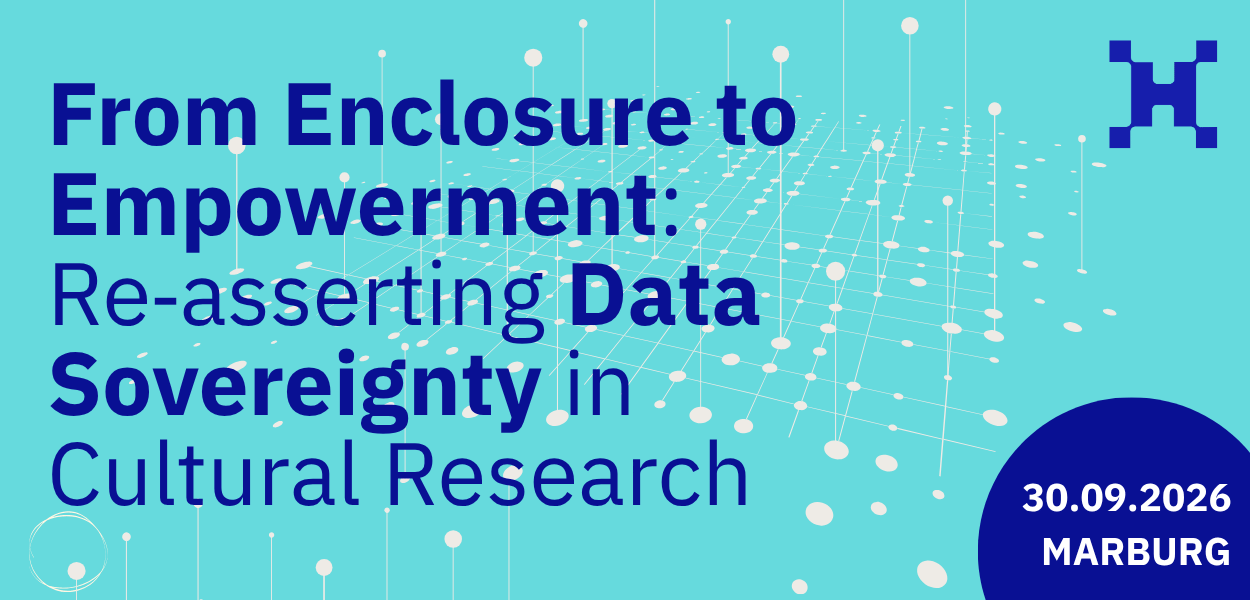
Datum: 30.09.2026
Uhrzeit: 11:30 bis 12:45 Uhr
Ort: Konferenzraum, Herder-Institute Marburg
Diese Veranstaltung wird organisiert durch das
Format:
Kommunikationsformate
From Enclosure to Empowerment
Re-asserting Data Sovereignty in Cultural Research
Supporting research and cultural institutions in achieving data sovereignty is a core aim of the HERMES project. Yet, the question remains: why is data sovereignty crucial for the humanities and cultural heritage, and why is it worth preserving or establishing in the first place? What does the growing threat to data sovereignty imply for cultural institutions? What must these organisations become – and remain – in order to retain control over their data? And has data sovereignty become wishful thinking rather than a realistic goal for the cultural sector?
At the forthcoming Open Colloquium at the Herder Institute in Marburg on Wednesday, the 30th September 2026 from 11:30am-1:00 pm, HERMES will focus on this issue and invite the audience to discuss the implications of an impending loss of data sovereignty. The opening talk, “Grand Theft Autocomplete: ‘AI’ Enclosures and Their Threat to Data Sovereignty,” delivered by Dr. Jonatan Jalle Steller (Academy of Sciences and Literature | Mainz), will map the terrain, highlighting both the dangers and the opportunities that arise.
Dr. Steller talks about how today, the distribution of research data and software relies heavily on the open web: largely standardised formats, decentralised data hubs, public availability, affordable computing, free learning resources, and findability afforded by a few ad-supported web indexes. This openness, however, is increasingly under threat. The companies that currently attempt to monetise large language models also make it much harder to keep websites online and position their chat interfaces as intermediaries between knowledge and users. The ‘AI’-enclosed web empowers Big Tech to further interfere in learning, education, and research.
His talk draws a parallel to the historical appropriation of common land in 18th- and 19th-century England. With this historical revolution of the rich against the poor to learn from, it outlines the specific dangers to the knowledge commons in the next few years. In conclusion, the talk attempts to identify what can be done to preserve and empower individual, institutional, and transnational data sovereignty in the face of this not entirely new threat: critique the neo-reactionary ideology behind the technology, empower ‘boring’ technology, identify affordable machine-learning tech, and embrace local and peer-to-peer computing.
Following the talk, a fish‑bowl discussion will bring together the audience, members of the HERMES data competence centre, and participants from the Digital History Autumn School. The discussion will focus on why data sovereignty matters for the humanities and cultural heritage, how it can be maintained or established, and what practical steps can be taken to ensure a resilient, sovereign data ecosystem in the cultural heritage sector.
Kontakt
Bei Fragen wenden Sie sich an:
Alexandra Büttner: alexandra.buettner@adwmainz.de